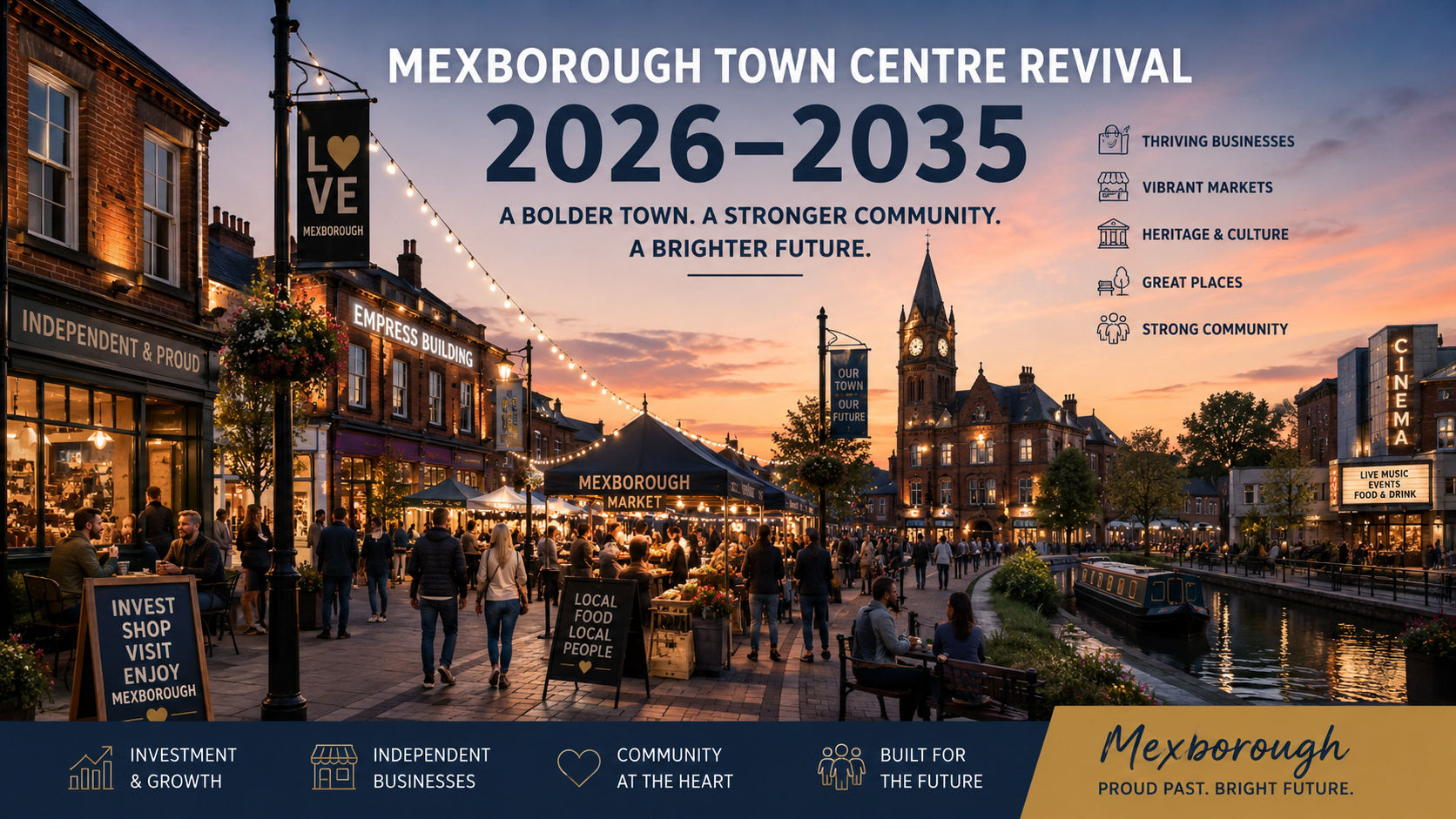
Mexborough Town Centre Revival Master Plan 2026–2035
A commercially led strategy for rebuilding footfall, investment, civic pride and destination value in Mexborough, South Yorkshire.
Mexborough is not a failed town. It is an undervalued town centre with weakened anchors, fragmented ownership, underused heritage assets, low-cost property, strong transport connectivity, an active resident base and significant emotional attachment from the community.
The decline visible in recent local discussion is consistent with wider UK high street trends: online shopping, edge-of-town supermarkets, retail parks, rising business costs, bank closures, reduced market relevance, changing work patterns and weaker town-centre habits. National retail evidence shows high street vacancy remains structurally higher than retail parks, with Savills reporting high street vacancy at 17.2% in late 2024 compared with 4.6% in retail warehousing.
Mexborough’s problem is not only physical appearance. The root problem is that the historic “weekly shop plus errands” model has disappeared. Comments from residents and traders repeatedly identify the loss of Tesco/Hillards, weakened market pull, early closing, parking concern, safety perception, loss of banks, lack of seating and toilets, roadworks and poor business mix as reasons not to visit.
Key findings
- Mexborough has lost its anchor trip. Lidl, supermarkets and online retail now capture convenience spending before people reach the High Street.
- Retail alone will not revive the town. The future must combine food, leisure, health, culture, services, housing, workspaces, events, markets and independent retail.
- Property values are low enough to create opportunity. Recent listings show High Street retail units at around £550 pcm, mixed-use assets around £100,000–£120,000, and investment stock showing yields far above national prime retail norms.
- Mexborough has transport advantages many small towns lack. It sits between Doncaster, Rotherham, Barnsley and Sheffield, with rail access, bus access, road links and a canal corridor.
- The town has heritage and visitor assets that are not yet packaged. The Empress Building, canal, market history, local independents, events, hospitality and new boutique accommodation are under-leveraged.
- Crime perception is commercially important. Public comments refer to anti-social behaviour, street drinking and safety concerns, and crime data shows above-average recorded crime for a small town, so perception cannot be dismissed.
- Existing public realm works are useful but insufficient. Doncaster Council identifies high vacancy, disrepair of landmark buildings and the need for public realm and services investment — but paving alone will not create demand.
Vision for Mexborough 2035
“South Yorkshire’s independent market, food, heritage and events town: affordable to trade in, easy to reach, proud of its history, alive after 5pm, and built around local ownership.”
This vision requires a commercially led revival: not waiting for grants, but mobilising landlords, businesses, residents, investors and civic groups around profitable, practical uses.
The reality of modern town centres
Why many high streets declined
The traditional high street was built around necessity: banking, groceries, market shopping, comparison retail, post office errands, bus access and social interaction. Over the past 20 years that model has been disrupted by online retail and home delivery, supermarkets offering one-stop shopping, retail parks with free parking, bank and post office closures, rising rent, rates, labour and energy costs, weaker weekday footfall due to work patterns, customer preference for speed and convenience, and reduced evening activity outside hospitality-led locations.
CBRE’s 2025 UK retail outlook highlights e-commerce, vacancy, consumer confidence and changing demand for prime space as central retail market issues. The House of Lords Built Environment Committee also framed high street resilience around mixed uses rather than retail-only recovery.
Why some towns are thriving
Successful towns have not simply brought shops back. They have created reasons to visit repeatedly. The strongest models combine a food hall or market anchor, independent businesses with clear identity, an evening economy, regular specialist markets, heritage and cultural venues, a residential population in and around the centre, active property owners, public realm that supports dwell time, safety and cleanliness management, and a strong place narrative.
Altrincham is the clearest example: its market revival created a food, drink and independent retail ecosystem, with independent shops and restaurants growing after the market’s success. Barnsley shows another model — retail plus leisure, health, events and culture, with The Glass Works helping generate major footfall recovery.
Core lesson for Mexborough
Mexborough should not copy Altrincham blindly. Altrincham has higher household affluence and Greater Manchester commuter dynamics. Mexborough’s model must be more affordable, practical and local: a working-class destination town built around food, events, services, heritage, health, markets and independent ownership.
SWOT analysis
Strengths
- Strong local identity and emotional attachment
- Good regional location between Doncaster, Sheffield, Rotherham and Barnsley
- Rail station and bus access
- Affordable commercial property
- Recognisable heritage assets, especially the Empress Building
- Existing independent traders with loyal customers
- Canal corridor and emerging accommodation offer
- Public realm investment already underway
- A large local conversation showing people still care
Weaknesses
- Lack of a strong town-centre anchor
- High vacancy and tired landmark buildings
- Fragmented business hours
- Negative perceptions around safety, anti-social behaviour and parking
- Weak evening economy
- Limited destination retail offer
- Overconcentration of low-dwell uses: barbers, vape shops, betting, discount, charity and convenience
- Insufficient seating, toilets and family-friendly dwell spaces
- Weak investor narrative
Opportunities
- Low acquisition prices for mixed-use buildings
- Upper-floor residential conversion
- Food hall / market dining model
- Health-on-the-high-street services
- Independent maker-retail
- Canal, heritage and event tourism
- Remote-worker workspace and local meeting rooms
- Family leisure and children’s activities
- Evening economy linked to events at the Empress Building
- “Shop local subscription” models
- Pop-up retail incubators
Threats
- Continued shift to online retail
- Further bank and service closures
- Landlord inaction
- Anti-social behaviour deterring families
- Poor coordination between traders
- Public realm works being mistaken for regeneration
- New businesses opening without market demand
- Community cynicism after years of decline
The investment case for Mexborough
Why Mexborough is undervalued
Mexborough’s property values are low relative to its regional access. Rightmove reports an average Mexborough property price of around £165,838 over the last year, substantially below UK averages. Commercially, High Street assets are available at entry-level pricing: recent examples include retail rent around £550 pcm and mixed-use High Street properties around £100,000–£120,000.
This creates an opportunity for patient local investors to buy, improve and re-let buildings at realistic rents. It also means entrepreneurs can test concepts at lower risk than in Sheffield, Doncaster or Barnsley.
Demographic opportunity
Mexborough ward has been cited with a population of around 15,238 and 6,601 households in local data sources, while Doncaster as a whole had a 2024 population of 319,765. The opportunity is not luxury retail. It is value-led, quality-led, convenience-led and community-led spending — affordable dining, family experiences, services people cannot buy online, local food, health and wellbeing, trades and repairs, event-linked hospitality, and specialist independent retail with regional pull.
Transport advantages
Mexborough benefits from rail, bus and road access. The station has step-free access from the car park to the entrance and ramped platform access via subway. Its location between Doncaster, Rotherham, Barnsley and Sheffield allows the town to target not only residents but visitors from surrounding settlements.
The commercial thesis
Mexborough can become a profitable low-cost testbed for independent operators if landlords and stakeholders package the offer properly: lower rents than major centres, access to a local catchment, heritage-led destination potential, event-led footfall, emerging accommodation, underused upper floors and visible vacant units ready for repositioning.
Hidden opportunities most people are missing
1. The town does not need more shops; it needs more missions
People visit modern town centres for missions: eat, meet, be entertained, work, learn, exercise, attend appointments, browse specialists, collect, repair, celebrate or socialise. Mexborough must design around these missions.
2. Upper floors are an economic engine
Vacant upper floors above shops can create residents, overnight stays, studios, therapy rooms, small offices and live/work units. More town-centre residents create repeat spending.
3. Health can replace lost retail anchors
Barnsley’s health-on-the-high-street model shows that clinics and diagnostics can drive predictable footfall. Mexborough should pursue private and community health uses: physiotherapy, dentistry, podiatry, audiology, mental health, mobility retail, GP overflow services and wellness clinics.
4. The Empress Building can be a town anchor
The Empress Building is already a restored heritage venue hosting weddings, tribute concerts, celebrity evenings and private functions, with boutique suites and adjoining dining. The town should build packages around it: pre-show meals, overnight stays, heritage walks, late cafés, taxi partnerships and event-night trader offers.
5. Remote working creates weekday demand
A small town-centre workspace, meeting room and business lounge could serve freelancers, tradespeople, consultants, remote workers and start-ups. A 10–20 desk flexible workspace above a shop could create daytime spend.
6. Mexborough can be a maker-market town
The town should not compete with Meadowhall or Parkgate. It should compete on authenticity: butchers, bakers, florists, repairers, makers, artists, food producers, vintage, interiors, children’s activities and events.
Business growth strategy
Businesses Mexborough should actively attract
- Food hall / market kitchen operator — small independent kitchens, bakery, coffee, street food, deli, dessert counter and evening dining.
- Family activity venue — indoor play café, children’s party venue, creative workshop space, mini golf, escape room or gaming lounge.
- Independent casual dining — pizza, burgers, tapas, grill, brunch, dessert, Sunday lunch, pre-show dining.
- Health and wellbeing cluster — physiotherapy, podiatry, audiology, private GP, counselling, mobility products, fitness studio, nutrition.
- Repair and reuse economy — phone repair, clothing alterations, shoe repair, bike repair, furniture upcycling, tool library.
- Local food and produce destination — butcher, greengrocer, baker, cheese, fish, deli, farm shop format, meal-prep provider.
- Creative and maker retail — local crafts, art, gifts, candles, clothing, vintage, records, books, homeware.
- Work and learning spaces — training rooms, adult education, digital skills, small business hub, podcast and content studio.
- Boutique accommodation support uses — breakfast café, luggage storage, visitor information, late dining, taxi and travel services.
Businesses to avoid over-supplying
- More low-quality vape shops
- More identical barbers
- More low-dwell betting and pawn uses
- Poorly differentiated takeaways
- Retail that can be bought cheaper online with no experience attached
- Businesses relying purely on passing trade without destination pull
Cluster strategy: four identifiable quarters
- Market & Food Quarter — street food, fresh produce, market dining, cafés.
- Heritage & Events Quarter — Empress Building, weddings, concerts, hospitality, accommodation.
- Health & Everyday Services Quarter — clinics, opticians, pharmacy, wellbeing, mobility.
- Maker & Independent Quarter — crafts, vintage, repair, workshops, pop-ups.
Hospitality and evening economy strategy
Mexborough cannot revive if it dies at 3pm. However, simply telling small shops to open later ignores the economics — traders have already said extended hours are often not viable without demand. The solution is not longer hours everywhere. It is coordinated evening trading on selected nights.
Recommended model
- Thursday: “Mexborough Late” until 7pm
- Friday: food, drink and live entertainment focus
- Saturday: market, family activity and event-linked trading
- Sunday: brunch, market and family leisure
Core hospitality actions
- Create a pre-show economy around Empress Building events
- Recruit 3–5 strong evening food operators
- Launch a monthly Mexborough Supper Street
- Support cafés to become evening dessert and coffee venues one or two nights per week
- Develop a family-friendly evening offer, not only alcohol-led nightlife
- Create safe taxi pick-up, lighting, stewarding and visible town ambassadors on event nights
Evening economy must be anchored around known demand. Event nights, market nights and themed trading create concentration. Random late opening creates losses.
Property and landlord strategy
Fragmented ownership and passive landlord behaviour can kill revival. Empty units, poor façades and inflexible leases send a signal that the town is failing.
Recommended landlord compact
Create a voluntary Mexborough Property & Investment Forum with landlords, agents, businesses and investors, to publish available units, agree model flexible leases, coordinate façade improvements, match start-ups with landlords, identify upper-floor conversion opportunities and create a town-centre investment prospectus.
Flexible lease models
- 3-month pop-up licence — low entry cost, fixed utility contribution, turnover option.
- 6-month test-and-trade lease — suitable for cafés, makers, repairers and services.
- Stepped rent lease — for example £300 pcm months 1–3, £450 pcm months 4–6, £600 pcm thereafter.
- Turnover-linked rent — lower base rent plus a percentage of sales.
- Community meanwhile use — empty units used for art, exhibitions, youth enterprise, local history and business trials.
Upper-floor strategy
Priority uses are residential flats, serviced rooms, studios, therapy rooms, small offices, training rooms and live/work units. The business case is supported by low purchase prices and achievable residential rents — one High Street mixed-use listing cited a two-bedroom flat producing £550 pcm alongside commercial income potential.
Investment prospectus recommendations
Prepare a 20-page investor pack showing available properties, rent levels, footfall estimates once measured, a catchment map, transport links, the event calendar, case studies, incentives from landlords, planning and use class guidance, and named local contacts.
Quick wins: 0–12 months
Medium-term actions: 1–3 years
- Establish a permanent food and market hall concept
- Convert priority upper floors into residential or workspace
- Recruit 10 destination independents
- Create a formal Mexborough business improvement-style partnership, even if not a statutory BID
- Acquire or long-lease one strategic community or business asset
- Develop a health and wellbeing cluster
- Build annual town events around food, music, heritage and family activity
- Create a town-centre safety and welcome plan
- Package rail, canal, heritage and events into visitor itineraries
- Create a landlord improvement standard for façades and vacant windows
Long-term vision: 3–10 years
By 2035, Mexborough should aim for vacancy below 8%; 50+ new town-centre homes or rooms; a recognised food and independent market offer; a functioning evening economy 3–4 nights per week; a health, wellbeing and services hub; a strong events and accommodation economy; a measurable visitor economy; a permanent town investment partnership; improved perception of safety; and a clear place brand known across South Yorkshire.
The 100-day action plan
Weeks 1–2: mobilise
- Form the Mexborough Town Team
- Identify 12 core stakeholders
- Agree one shared objective: increase reasons to visit
- Start a vacant unit audit
- Start a business opening-hours audit
Weeks 3–4: evidence and mapping
- Map all businesses by category
- Map vacant units and landlord contacts
- Map parking, seating, toilets, bus stops, station route and event venues
- Gather baseline footfall using manual counts at set times
- Identify the top 20 visual problems
Weeks 5–6: public-facing quick wins
- Launch “What’s Open in Mexborough”
- Create a town centre WhatsApp or email alert for traders
- Start empty-window dressing
- Publish the first event-night itinerary
- Recruit ambassadors
Weeks 7–8: commercial packaging
- Create the investor one-pager
- Prepare a list of target businesses
- Contact property agents and landlords
- Draft a flexible lease template
- Identify 3 units suitable for pop-ups
Weeks 9–10: pilot activity
- Run the first coordinated late-opening evening
- Run the first maker and food pop-up
- Test event-night hospitality offers
- Collect customer feedback and sales data
Weeks 11–12: safety and perception
- Undertake a safety walk with traders, residents and police
- Identify lighting, seating, ASB and cleanliness priorities
- Launch a “report, resolve, reassure” protocol
- Publish visible improvements
Weeks 13–14: investment outreach
- Invite local investors to a breakfast briefing
- Tour vacant buildings
- Present mixed-use conversion opportunities
- Match entrepreneurs with landlords
Weeks 15–16: review and scale
- Publish a 100-day progress report
- Compare footfall, sales feedback and vacancies
- Decide which pilots become monthly fixtures
- Set the 12-month delivery plan
Success metrics
Footfall: manual baseline counts at 10am, 1pm, 3pm and 6pm; monthly comparison; event-night uplift.
Vacancy: number of vacant units, dressed vacancies, units under offer and units reoccupied.
Business growth: new openings, pop-up trials, survival after 6 and 12 months, trader revenue feedback.
Property: investor enquiries, lease completions, upper-floor conversions, façade improvements.
Visitor economy: event attendance, accommodation occupancy, restaurant bookings, out-of-town visitors.
Perception: resident sentiment survey every six months, safety perception score, cleanliness score, and a “would you recommend visiting Mexborough?” score.
Benchmark lessons for Mexborough
- Altrincham — a market or food anchor can reposition a town, but it must be authentic and operator-led. Replicate the principle, not the price point.
- Barnsley — retail recovery works when combined with leisure, public space, health and culture. Copy the mixed-use logic at a smaller scale.
- Todmorden — market towns benefit from flexible public spaces, seating, greenery, specialist markets and heritage framing.
- Hebden Bridge — local ownership and independent identity protect a town from becoming cloned. Build local asset ownership and community business models.
- Wigan — town revival should include culture, events, public space and residential repopulation, not just retail.
- Stockton-on-Tees — sometimes the bold move is to reduce weak retail space and create public realm, events, housing and leisure instead. Accept that some retail units may need alternative uses.
Risks and mitigation
Final strategic recommendation
Mexborough should stop trying to become a traditional shopping town again. That model has gone.
The commercially viable future is a mixed-use destination town built around independent food, events, health, services, heritage, affordable enterprise, upper-floor living and community ownership.
The town’s revival will not come from one grant, one council scheme or one large retailer. It will come from 100 coordinated small moves: landlords becoming flexible, traders acting together, residents spending locally, investors buying and improving property, venues creating footfall, and the town telling a stronger story.
Mexborough does not need to wait to be saved. It needs to organise its assets, package its opportunities and trade with confidence.
Frequently asked questions
What is the Mexborough Town Centre Revival Master Plan 2026-2035?
It is a commercially led ten-year strategy for rebuilding footfall, investment and destination value in Mexborough, South Yorkshire. Rather than trying to restore a traditional shopping high street, it repositions the town around independent food, markets, events, heritage, health services, affordable enterprise space and upper-floor town-centre living.
Why has Mexborough town centre declined?
Mexborough lost its anchor trip. The historic model of a weekly shop plus errands disappeared as online retail, edge-of-town supermarkets and retail parks captured convenience spending, and as banks, the post office and market pull weakened. Residents and traders also cite early closing, parking concerns, safety perception, a lack of seating and toilets, roadworks and a poor business mix. National evidence shows this is a structural UK high street trend, not a Mexborough-specific failure.
Is Mexborough a good place to invest in property or open a business?
The plan argues Mexborough is undervalued relative to its regional access. Average property prices sit around £165,838, High Street retail units have listed at around £550 pcm and mixed-use High Street buildings at roughly £100,000–£120,000. Combined with rail, bus and road links to Doncaster, Rotherham, Barnsley and Sheffield, this makes the town a low-cost testbed for independent operators and a patient-investor opportunity for buying, improving and re-letting buildings.
What kinds of businesses should Mexborough attract?
Priority sectors are a food hall or market kitchen operator, family activity venues, independent casual dining, a health and wellbeing cluster, the repair and reuse economy, local food and produce retail, creative and maker retail, work and learning spaces, and support uses for boutique accommodation. The plan advises against over-supplying vape shops, identical barbers, low-dwell betting or pawn uses, and undifferentiated takeaways.
What role does the Empress Building play in the revival plan?
The Empress Building is identified as a potential town anchor. It is a restored heritage venue hosting weddings, tribute concerts, celebrity evenings and private functions, with boutique suites and adjoining dining. The strategy recommends building an event-led economy around it: pre-show meals, overnight stays, heritage walks, late cafés, taxi partnerships and coordinated event-night trader offers.
How should Mexborough approach its evening economy?
Not through blanket late opening, which loses money for small traders. The plan recommends coordinated evening trading on selected nights: a Thursday “Mexborough Late” until 7pm, a Friday food, drink and entertainment focus, Saturday market and family activity trading, and Sunday brunch and leisure — all anchored to known demand such as event nights and market nights.
What are the first steps in the 100-day action plan?
Weeks one and two focus on mobilising: forming a Mexborough Town Team, identifying twelve core stakeholders, agreeing a single shared objective of increasing reasons to visit, and starting audits of vacant units and business opening hours. Evidence gathering, public-facing quick wins, commercial packaging, pilot trading nights, safety work and investor outreach follow in two-week blocks.
How will success be measured?
Through footfall counts at 10am, 1pm, 3pm and 6pm with monthly comparison; vacancy figures including dressed, under-offer and reoccupied units; new business openings and survival at six and twelve months; investor enquiries, lease completions and upper-floor conversions; event attendance and accommodation occupancy; and a six-monthly resident sentiment survey covering safety, cleanliness and willingness to recommend visiting.